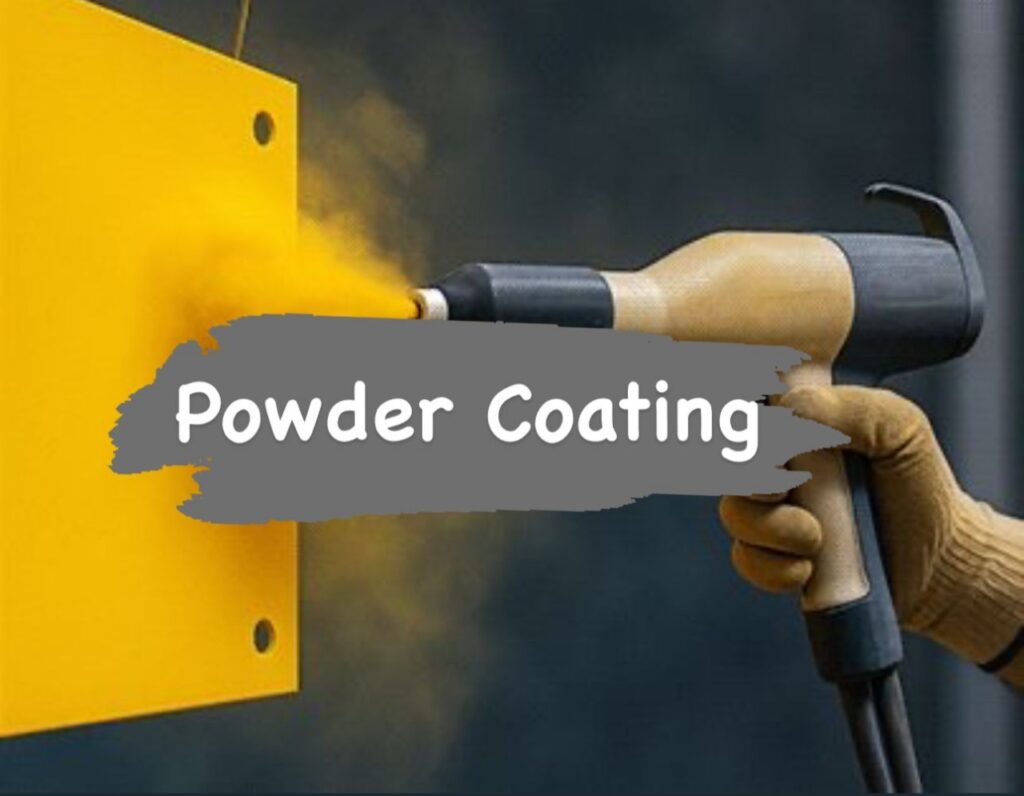
- Powder coatings are dry finishing materials composed of finely ground pigments, resins, and additives. Unlike liquid paints, they are applied as a dry powder and then cured under heat to form a durable, uniform, and protective coating. Powder coatings are widely used in industrial and decorative applications due to their environmental friendliness and superior performance.
- Applications
- Metal Furniture: Office and home furniture with smooth, colorful, and scratch-resistant finishes.
- Automotive Components: Wheels, chassis parts, and trims requiring durability and corrosion resistance.
- Appliances: Refrigerators, washing machines, ovens, and other household appliances.
- Architectural Elements: Window frames, doors, panels, and railings exposed to weather.
- Industrial Equipment: Machinery, pipelines, and structural steel requiring long-lasting protection.
- Types of Powder Coatings
- Thermoplastic Powder Coatings: Melt when heated and solidify upon cooling; can be remelted.
- Thermosetting Powder Coatings: Form a chemical cross-linked network when cured; highly durable and cannot be remelted.
- Epoxy Powder Coatings: Excellent corrosion resistance, chemical resistance, and adhesion; mainly for indoor use.
- Polyester Powder Coatings: UV-resistant, suitable for outdoor applications with color stability.
- Hybrid and Specialty Powders: Combinations of resins or functional additives for specific properties like texture, metallic effects, or anti-bacterial surfaces.
- Application Process
- Surface Preparation: Clean, degrease, and sand or blast the substrate for optimal adhesion.
- Powder Application: Electrostatic spray guns apply charged powder particles evenly.
- Curing: Heated in an oven at 160–200°C for 10–20 minutes to form a smooth, durable coating.
- Advantages
- Environmentally friendly (low VOCs)
- High durability, chemical, and corrosion resistance
- Uniform thickness and smooth finish
- Minimal waste and efficient process
- Powder coatings are widely recognized for their protective and decorative qualities, offering long-lasting performance across various industrial, automotive, and architectural applications.
- Raw Materials:
- 1. Resins / Binders
- Epoxy resins: Provide chemical resistance and adhesion
- Polyester resins: Offer UV stability for outdoor applications
- Hybrid resins (Epoxy-Polyester): Combine durability and weather resistance
- Acrylic resins: Used for smooth finish and color retention
- Function: Form the continuous film that binds pigments and fillers to the substrate.
- 2. Pigments / Colorants
- Inorganic pigments: Titanium dioxide (white), iron oxides (red, yellow, black)
- Organic pigments: Provide bright and vibrant colors
- Metallic pigments: Aluminum, copper, or pearlescent effects
- Special effect pigments: Fluorescent, pearlescent, or mica-based
- Function: Provide color, opacity, and decorative effects.
- 3. Fillers / Extenders
- Calcium carbonate
- Barium sulfate
- Silica
- Talc
- Function: Control film thickness, improve mechanical properties, and reduce cost.
- 4. Curing Agents / Hardeners
- Epoxy hardeners: Amine or acid anhydride types for cross-linking
- Polyester curing agents: TGIC (Triglycidyl isocyanurate) or alternative cross-linkers
- Function: Enable chemical cross-linking during curing to form a tough, durable coating.
- 5. Additives
- Flow and leveling agents
- Anti-caking agents
- Degassing agents
- UV stabilizers
- Conductive or anti-corrosion additives